

Dental bridge lifespan varies with the bridge design, its supporting teeth or implants, and the health of the surrounding gums. A well-cared-for bridge may function for many years, but cementing it in place does not make it permanent or set a fixed replacement date.
Key Takeaways
- How long does a dental bridge last? A commonly cited working range for a conventional tooth-supported bridge is around 5 to 15 years, though some last longer.
- What affects its lifespan? Bridge design and material matter, as do the bite, the supporting teeth, implants, and gum health.
- Can teeth decay under a bridge? Yes. Supporting teeth can develop decay, especially around areas where plaque collects near the bridge margins.
- How do you clean underneath a fixed bridge? Use a floss threader or a suitably sized interdental brush each day, alongside brushing and any other method your dental professional recommends.
- What can damage a bridge? Grinding, clenching, chewing very hard objects, and biting non-food items can strain the bridge or its supports.
- Where can you find practical care guidance? Our preventive and seasonal dental care tips offer additional advice for maintaining oral health.
I am Dr. Theodore Ionescu, and I look at this the same way in the chair: the tooth, the bite and the gums get examined together before anyone recommends treatment. Our office on Elk Grove Boulevard keeps sixty minute appointments for exactly this reason, so the exam and the questions are not compressed into ten minutes. If a tooth has already been worked on somewhere else and you want a second opinion, call (916) 685-4662 and bring whatever X-rays you have.
How Long Can a Dental Bridge Last?
A fixed dental bridge is not permanent. A commonly cited working range for a conventional tooth-supported bridge is around 5 to 15 years, and some continue functioning longer; that range describes general experience, not a personal prediction or a deadline for replacement.
Estimates can also measure different outcomes. A bridge may still be in place after a repair, so a study counting whether it remains in use can report a different result from one counting bridges that have had no complications.
For example, the European Federation of Periodontology reported a failure rate of 14.4% (16 out of 111 bridges) after an average of 16.1 years in a study of cross-arch bridges in patients with stage III/IV periodontitis. That result describes the bridges and patients in that study, not the expected lifespan of every dental bridge.
Rather than assigning a bridge a standard replacement age, a dentist assesses its fit and condition over time, along with the health of its supports. For people asking how long a dental bridge lasts, those continuing checks help turn a broad estimate into an individual outlook.
This infographic highlights questions to discuss about dental bridge lifespan. It covers factors that can affect how long a dental bridge lasts.
Bridge Design, Material, and Location All Matter
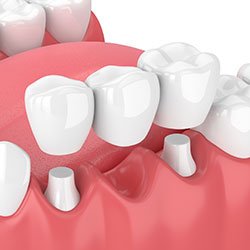
Bridge design determines how the replacement tooth is supported, and different designs place forces on different structures. A traditional bridge uses teeth on both sides of the gap, while a cantilever bridge attaches to support on one side; a Maryland bridge uses bonded wings, and an implant-supported bridge is anchored to dental implants.
| Bridge type | How it is supported | What that means |
|---|---|---|
| Traditional | Teeth on both sides of the gap | Adjacent teeth support the replacement tooth. |
| Cantilever | Teeth on one side of the gap | The design relies on support from one side. |
| Maryland | Bonded wings attached to neighboring teeth | The wings help hold the replacement tooth in place. |
| Implant-supported | Dental implants | Implants anchor the bridge without relying on adjacent teeth for support. |
These support differences can affect how a bridge responds to problems. With a traditional bridge, both abutment teeth need to remain healthy. A cantilever relies on support from one side, so excess bite pressure can put that support under strain. A Maryland bridge may loosen if a bonded wing debonds, even when the replacement tooth itself is intact. An implant-supported bridge does not rely on neighboring teeth for support, but its outlook still depends on the implants and surrounding tissues.
A porcelain-fused-to-metal bridge has a metal framework covered by a tooth-colored surface. All-ceramic bridges avoid a metal framework; the choice balances appearance and strength with the position of the bridge and the forces of a person’s bite.
There is no universal lifespan ranking by material alone. The porcelain facing on a porcelain-fused-to-metal bridge can chip even if its metal framework remains intact; all-ceramic bridges have no metal framework and can also be vulnerable to chipping under excessive force. Bite, location, fit, and the health of the supports all matter when judging how long either type may remain serviceable.
Back teeth take substantial chewing forces, while front teeth have different biting and appearance demands. A dentist considers the location and bite when choosing a design and material, because a restoration must work under the conditions it will face.
With an implant-supported bridge, the bridge and the implants have related but distinct outlooks. Implants do not decay, but the surrounding tissues can develop problems and prosthetic components still require care, so keeping the area clean and attending dental reviews remain important.
A conventional tooth-supported bridge has a commonly cited working range of around 5 to 15 years. There is no single directly comparable lifespan figure for an implant-supported bridge: the bridge and the implants are separate parts, and the bridge may need repair or replacement while an implant remains stable. Problems in the tissues around an implant can also affect support. An implant therefore does not guarantee that the whole restoration will outlast a conventional bridge by a set amount. For more on the differences, see dental implants vs bridges.
Did you know? The cumulative survival rate for short-span FDPs was 34% in year 15. (BMC Oral Health)
The 34% callout is a cumulative survival estimate for short-span fixed dental prostheses in the cited study. It describes the study group meeting that study’s definition of survival at the stated time point; it is not a prediction that an individual bridge will last that long or remain free of complications. Read it as a study-specific result, not as a replacement for the broad working range above.
Supporting Teeth and Gums Are Part of the Bridge
The abutment teeth are the teeth that support a bridge, and the pontic is the replacement tooth spanning the gap. If an abutment develops decay or fractures, the whole restoration may lose support even when the pontic and visible surfaces still look intact.
Plaque can collect around bridge margins, where it may contribute to decay in a supporting tooth. Gum inflammation and periodontal disease can also weaken the tissues that support teeth, which is why the condition of the bridge supporting teeth matters as much as the restoration itself.
Survival of conventional bridge abutments has been shown to be 72% at 10 years, according to the Journal of Dentistry. This is a measure of supporting-tooth survival, not a measure of how long every bridge remains free of complications.
We tailor reviews and maintenance to the bridge design, the condition of its supports, the bite, and a person’s history of decay or gum disease. At a review, a dentist can examine the bridge margins, supporting structures, and bite, then decide whether further assessment or care is appropriate.
Clean Under the Bridge and Around Its Supports
Brush the bridge and gumline twice a day with a soft-bristled toothbrush. Cleaning the edges helps control plaque near the margins, where buildup can affect both gum health and supporting teeth.
Clean under the pontic every day with a floss threader or an appropriately sized interdental brush. Ordinary floss may not pass through the space under a bridge as it does between natural teeth, so use a method designed to reach beneath the replacement tooth and around the supports.
A water flosser can help flush beneath a bridge and around its supports, but it should complement brushing and mechanical cleaning rather than replace them. The right method depends on the bridge’s shape and your dexterity, so ask a dental professional to demonstrate a safe technique that fits your restoration.

Limit Grinding, Hard Chewing, and Other Strain
Avoid chewing ice, hard candies, and other very hard objects because concentrated force can chip a ceramic surface or strain the bridge and its supports. Do not use your teeth to open packages or bite non-food items, which can apply uncontrolled force to the restoration.
If you grind or clench your teeth, tell your dentist. Repeated bruxism forces can wear or fracture restorations, and a professionally fitted night guard may be recommended to protect the bridge and the rest of your teeth.
Ask for a bite assessment if chewing feels uneven or a new bridge seems to contact first. Persistent excessive pressure can strain the bridge and its supports, so the dentist can check the contact and decide whether adjustment is needed.
Did you know? The cumulative survival rate for long-span FDPs was 18% in year 15. (BMC Oral Health)
Know When to Arrange a Dental Assessment
Arrange a prompt assessment if the bridge feels loose, fits differently, or develops a new click or movement. These changes can result from cement failure or a problem with a support, and delaying an assessment may allow the underlying issue to worsen.
Seek dental care for pain when chewing, persistent sensitivity, swelling, bleeding, or a bad taste around the bridge. These symptoms can point to a problem involving a supporting tooth, gum tissue, or the restoration.
Contact a dentist promptly if the bridge cracks, chips, or breaks, even if it still appears attached. Damage can expose vulnerable areas or change the way the teeth meet, and an intact appearance alone does not establish that the bridge is healthy.
Repair, recementing, or dental bridge replacement depends on the cause and extent of the damage and the condition of the supports. A dentist examines those factors before recommending how to restore comfort and function.
Frequently Asked Questions
How long does it take to get used to a new dental bridge?
Your tongue and cheeks may need time to adjust to the bridge’s shape, and speech or chewing can feel unfamiliar at first. If the sensation persists or the bridge interferes with your bite, contact your dentist for an assessment.
Can a loose dental bridge be removed and recemented?
Sometimes, if the bridge is undamaged, still fits correctly, and its supporting tooth or teeth are healthy. Do not use household glue; a dentist can remove old cement, examine the supports, and decide whether recementing is appropriate.
Can a dental bridge be repaired without replacing the whole bridge?
Some limited chips or surface damage can be repaired or smoothed, depending on the material and location. Damage to a connector or a supporting tooth may require a more extensive solution, so the dentist needs to inspect the restoration before choosing a repair.
What should you do if a bridge comes out?
Keep the bridge in a clean container and contact your dentist promptly to arrange an assessment. Avoid chewing on that side and do not try to force the bridge back into place, since it may not seat safely.
Can a dental bridge change the way you speak?
A new bridge can briefly change how your tongue contacts the teeth, especially when the restoration is near the front of the mouth. Reading aloud can help you notice whether particular sounds remain difficult, and your dentist can check the bridge’s shape if the change continues.
What can happen if you leave the space after a bridge comes out?
Over time, nearby teeth may shift toward an open space, which can affect how the teeth meet and how a replacement fits. Your dentist can assess the area and discuss suitable next steps based on the condition of the teeth and gums.
What is the downside of having a dental bridge?
A traditional bridge relies on neighboring teeth for support, and those teeth can be vulnerable to decay or damage. Bridges also need careful cleaning around and underneath them, and they may eventually need repair or replacement.
Protecting Your Dental Bridge Over Time
Dental bridge lifespan depends on more than the material or the number of years since placement. Good daily cleaning, sensible habits, a comfortable bite, and regular professional assessment help protect the bridge and the structures that support it.
Whether you are considering a dental bridge in Elk Grove or already have one, we recommend judging it by its condition rather than a fixed age. Contact your dentist when its fit, comfort, or appearance changes so that concerns can be assessed before they become harder to address.
If any of this matches what you are feeling, the next step is an exam rather than a search. Call Dentistry by Design at (916) 685-4662 or request an appointment. We will show you what we see and tell you what it will take.